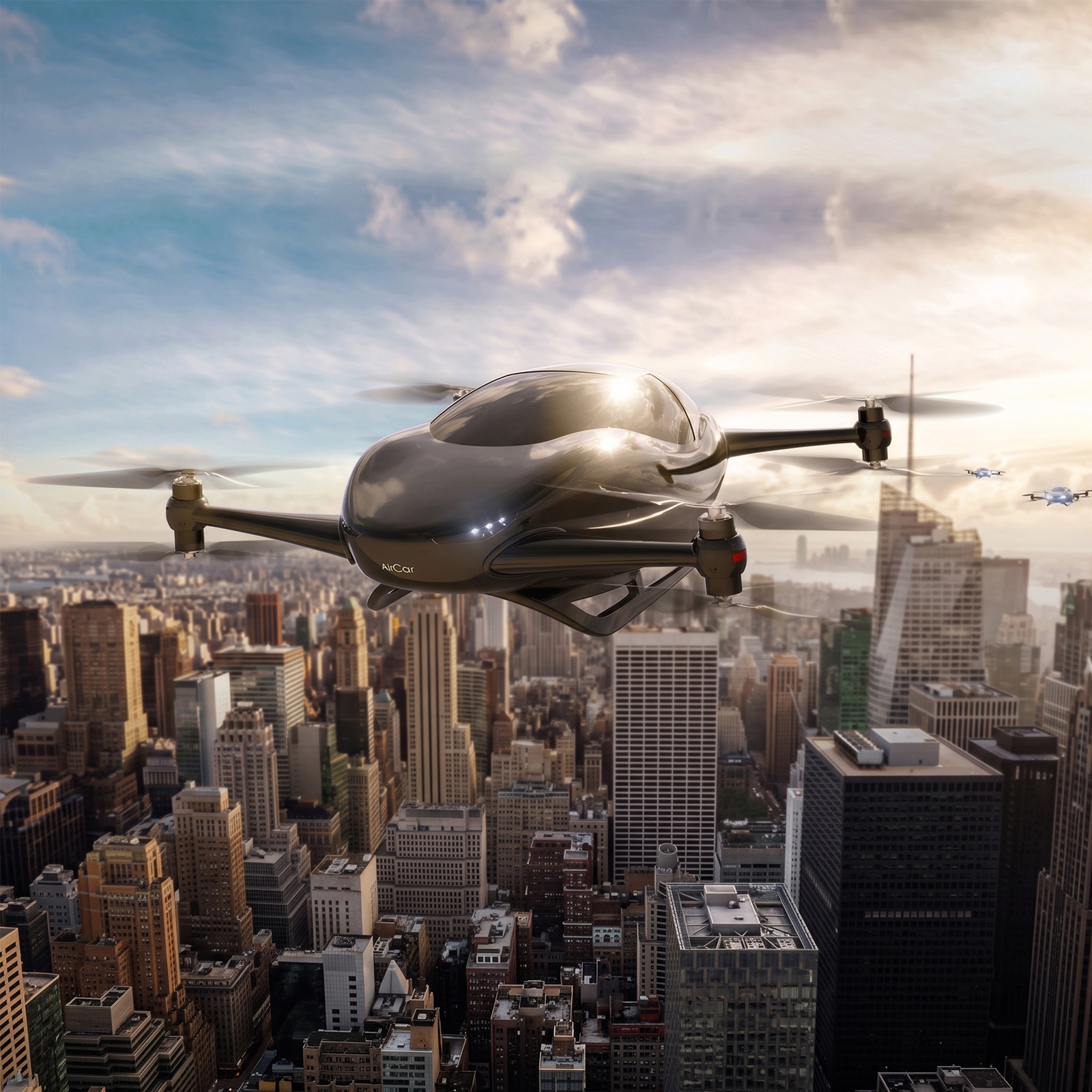
An award-winning aircraft design that combines aerodynamic fluidity with futuristic automotive aesthetics for 100% electric, vertical take-off and landing (eVTOL), and autonomous urban air transport.

The chronic traffic congestion of today's metropolises makes it necessary to move our transportation vision from two dimensions to three.AirCar Corp.(AirCar Technology and Aviation Inc.), an Istanbul-based Turkish aviation technology startup, is pioneering the future air taxi ecosystem by developing 100% electric, vertical take-off and landing (eVTOL), and autonomous aircraft for urban air transport.
AsDesignPerest Studio, we provided industrial design development partnership to the project founded by Eray Altunbozar between 2019-2021. In the flying car concept; we combined aviation aerodynamics with futuristic automotive aesthetics in the form of a safe passenger capsule gliding in the sky.
“AirCar revolutionizes urban air mobility with its 100% electric vertical take-off and landing technology aimed at overcoming city traffic from the air, its autonomous infrastructure, and its futuristic design.”

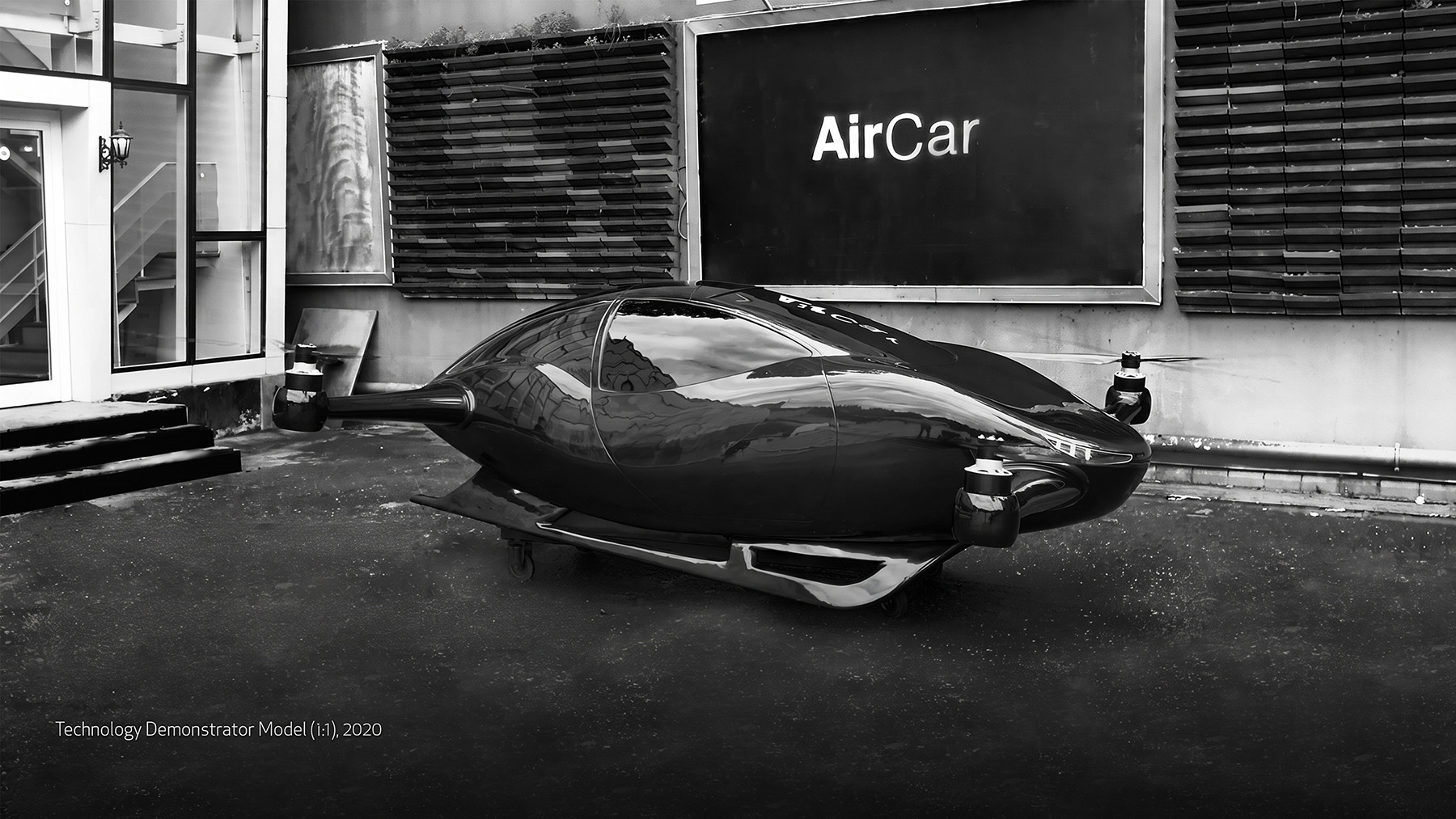
Aircraft body silhouette and canopy form explorations that optimize vertical take-off and horizontal cruise aerodynamics.

Class-A surface modeling in G2 continuity and rotor arm integration for the lightweight carbon monocoque body.

Fluid carbon composite rotor carrier arms that do not block downward airflow (downwash).
While every gram is calculated in aviation, the visual elegance of the design is equally important. AirCar's monocoque body was shaped with carbon fiber composite panels that minimized weight and maximize torsional rigidity.
The fluid body form, which does not block the airflow generated by the rotors during vertical take-off, breaks air resistance when transitioning to horizontal cruise speed, allowing it to reach a cruising speed of 70 knots (approx. 130 km/h) while expanding minimum energy. Dynamic headlight lines and futuristic contours inspired by automotive design give AirCar an instantly recognizable iconic air taxi identity in the sky.


Instead of the complex cockpit instruments of traditional helicopters or light aircraft; a minimalist, spacious, and reassuringinterior designthat reflects the autonomous travel understanding of the future was structured in the AirCar cabin. The wide panoramic glass canopy grants two passengers the privilege of watching the city skyline 360 degrees.
Offering a payload capacity of 500 lbs (approx. 226 kg), the interior volume was equipped with ergonomic passenger seats, in-cabin air circulation channels, and an autonomous route tracking screen developed in partnership with Softtech.

Lightweight composite glass roof architecture with no optical distortion offering the opportunity to view the city skyline 360 degrees.

A simple digital touchscreen cockpit that conveys flight altitude, arrival time, and route telemetry to passengers.
Comfortable passenger seats covered in lightweight aviation-grade fabric with shock-absorbing suspension.


Designed in accordance with Light Sport Aircraft (LSA) global standards, AirCar has multi-layered safety redundancy. There is an autonomous avoidance system that detects buildings, poles, and other aircraft on the flight path with AI sensors. In the event of any engine or system failure, a full emergency ballistic parachute hidden in the roof compartment deploys in less than a second, bringing the vehicle safely to the ground.
The 22 kWh battery pack supports 400V DC fast charging technology; ensuring the fleet remains airborne uninterrupted by charging rapidly during short passenger boarding/alighting intervals at the landing pad (vertiport).

Lithium battery module with 400V DC fast charging support embedded in the body floor providing a low center of gravity.

Fluid body form optimized with a drag coefficient target of 0.28 Cd, breaking air resistance when transitioning from vertical take-off to horizontal cruise speed and supporting a cruising speed of 70 knots.
Maximum structural torsional rigidity and high payload capacity with an ultra-light carbon fiber monocoque shell.
Glass canopy offering a 360-degree city view, intuitive touch interface, and 2-person passenger comfort ergonomics.
Ballistic body parachute deployed in less than a second in emergencies and multi-layered sensor redundancy.
Urban air taxi form language, aerodynamic silhouette, and passenger capsule sketches.
Class-A G2 surface fluidity, canopy curves, and rotor placement modeling.
Wind tunnel simulations, vertical take-off airflow, and cruise drag tests.
Passenger viewing angles and HMI validation on a full-scale cabin mock-up.
Vertical take-off, hover, and autonomous cruise tests with a full-scale prototype.